AskBob Intelligent Office Assistant — Voice Conversation Enhancements
Jan 2019 - Mar 2020
Product Designer
20 mins
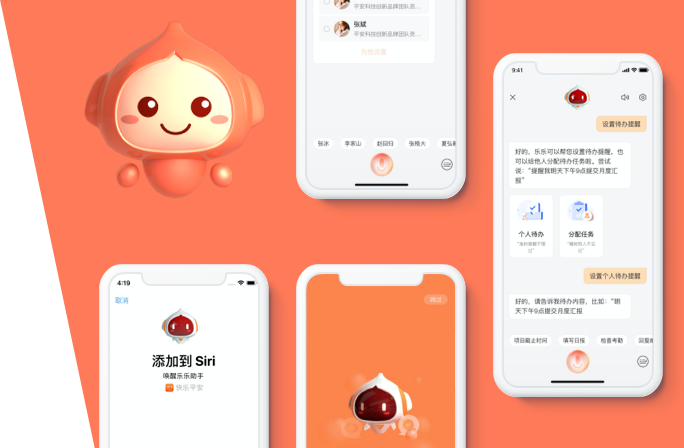
AskBob is an exclusive intelligent voice assistant named Bob in Ping An Group's internal IM software, standing for "Beyond Our Mind." It assists users with daily task management, such as voice-booking meetings, sending emails, reminding of to-dos, travel itineraries, finding colleagues, answering daily Q&A questions, and other high-frequency office quick operations.

1) During the pandemic, we hoped to guide remote employees to use the AskBob assistant to resolve office questions, alleviating the personnel shortage on the IT service platform during the pandemic.
2) Before the pandemic, AskBob adopted duplex voice technology. We hoped the new technology could match appropriate interactions to smooth the voice experience, and partially mask technical deficiencies at the interaction level.
1. When users open the app, Bob's actual conversation rate was 4.35% (users who actively asked Bob questions), at a relatively low level, with many work scenarios uncovered.
2. The average user ends the conversation after 2.56 rounds.
3. Most users end the conversation after 2 rounds without chatting with Bob. Efficiency first. At most, one user had 32 rounds with Bob.
Data source: Tianyan
1. 8040 (User) / 183788 (DAU)

To better improve AskBob for high-frequency use across various scenarios, we organized user voice interaction frequency by timeline. We found that there are development scenarios in mobile check-in and audio task scenarios.

The Q&A mechanism during the pandemic basically met users' needs. Interface usage is approaching saturation, requiring more voice improvements and more empowered functional scenarios. The number of AskBob users is very limited, only 4.37%, requiring improvements to AskBob's conversation capabilities. Voice experience needs to be optimized to improve AskBob's all-day call rate, especially helping users during peak commute hours and business travel scenarios.
Improve AskBob's continuous conversation capability. The immersiveness of the conversation experience is not strong enough, causing UI element usage to exceed voice function calls. With duplex voice technology, the experience will greatly improve. Further improvements in conversation strategy.
Design considerations coupled with technical difficulty
Before - No wake-up word in in-app voice, wake-up word error tolerance and prevention
After - Wake-up words: "Hi Bob, little secretary" etc., guiding users into conversation mode
Goal - Improve error prevention and tolerance, help users perceive the robot's intelligence more comprehensively, guide users into conversation mode

Before - When user doesn't respond, robot ends conversation directly
After - When user doesn't respond, use follow-up reply urging scripts, e.g., "Are you there? Please speak." Optimize asymmetric conversation interaction.
Goal - Make conversations more natural, intuitive, and efficient.

Before - Robot broadcast cannot be interrupted in multi-turn conversations
After - In duplex mode, when the robot has long content to broadcast, it can be interrupted, prioritizing uplink user conversation
Goal - Respond to user feedback promptly
Before - When computing power is insufficient and user's questioning speed exceeds robot's response speed, robot cannot answer
After - Users use intent-execution reply preamble scripts to make conversation more natural. Estimate high-latency mitigation experience, optimize remote task experience

